

Why The Mask?
It began as a joke.
I already owned a few gas masks. Eventually, I began to collect them. I have them from different eras. Different corners of the world.
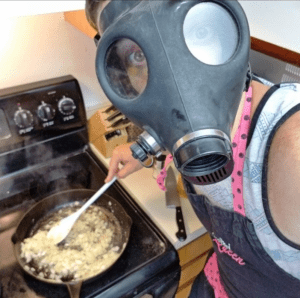
I was making dinner. Cutting onions. He left the room and I thought it would be funny if he came back and I was wearing one of the masks, claiming they were making my eyes water. He thought it was funny. I cooked the onions wearing the mask the entire time. I took a selfie.
That was it.
There was no plan, no philosophy and certainly no expectation that the silly thing would become an identity I would still be wearing years later. It was a gas mask in a kitchen. It protected me from absolutely nothing that required a gas mask. This amused me.
Then my first published story, “Clinical Trial,” appeared in A Cure for Chaos. The contributing authors were asked to create Amazon Author pages so the publisher could connect us properly to the book.
Suddenly, I needed an author photograph.
But which photograph?
I had also written “Chasing Ghost Trains,” a story about a teenage boy masturbating to pictures of trains.
Sexy, sexy trains.
There could be consequences. People might begin to suspect that I was some kind of weirdo. This must certainly never happen.
I am a weirdo, obviously, but as Cardi B says in “Up”: no face, no case.
Find the author of “Chasing Ghost Trains” peacefully living his life in the world. Find the author of “Seeking Vorarephile,” in which two men meet through Craigslist personals and ultimately become consumed by eroticism, consumed by love and consumed by one another.
Go on. Find him.
Find the man responsible for “Fingers,” “The Rash” or “Touch Yourself Again…” Look directly into the face of this entirely stable person who is absolutely not a psycho.
You can’t.
Dumb bitch.
That was the whole point.
At first.
The Joke Becomes Something Else
As my writing grew bolder, so did the subjects I chose to explore. I became increasingly aware of both my ability and my responsibility to create the protagonists I had spent much of my life searching for.
Queer people were never absent from horror. We were hidden inside it, coded into it, punished by it and transformed into monsters by people who feared what they refused to understand. We were present as implication, pathology, tragedy and threat. Far less often were we permitted simply to be the people whose lives mattered.
I could change that within my own work.
I could breathe those missing protagonists into life.
My characters could be gay, lesbian, bisexual, transgender, nonbinary, intersex, asexual, aromantic or otherwise queer. They could love, desire, grieve, laugh, fail, survive and occasionally become the incomprehensible thing dripping blood across someone else’s floor.
Their identities could inform their lives without becoming the only reason those lives existed.
I do not need to share every aspect of a character’s identity to recognize that they deserve interiority, agency and a place at the center of the story. I do not need to be an asexual person, a lesbian or a trans woman of color to watch the world around me. I can notice microaggressions. I can recognize enormous and entirely intentional aggressions. I can see how frequently people who consider themselves superior become disproportionately cruel toward queer people.
That recognition does not grant me ownership over anybody else’s experience.
I cannot speak to the totality of a life I have not lived. I cannot know precisely what another person feels, and I try not to write as though I do. Often, I do not need to tell the reader what my characters feel. I can show what is happening around them and trust the reader to recognize it.
If you have ever been exposed when you did not want to be, you know something about vulnerability.
If someone has questioned your agency to name and define yourself, you know something about erasure.
If you have ever realized that an ordinary interaction could spiral suddenly into humiliation, violence or mortal danger, you know how quickly the world can change beneath your feet.
You may not know another person’s exact experience. Neither do I. But we can recognize the shape of what is being done to them.
We can decide not to look away.
I Do Not Speak For You
I am not a representative appointed to speak on behalf of any individual or community. Nobody has asked me to do that, and I would not be so arrogant as to presume that I could.
I speak from what I have witnessed with my own eyes.
I have experienced discrimination and hatred. I have watched people be misgendered. I have heard them called slurs. I have seen others challenge their right to define themselves, as though identity requires the approval of strangers. I have watched people attempt to take someone’s dignity and then behave as though the violence lay in objecting to it.
If I have seen these things, you have probably seen them too.
When they happen, there is a moment in which everyone nearby makes a choice. Someone is being isolated. Someone else can refuse to let them stand alone.
I hope you speak.
I hope you step forward and make it clear that the person being targeted has not been abandoned to face the cruelty by themselves. I hope your voice joins theirs—not to replace it, not to overwhelm it and not to claim their experience as your own, but to ensure that it can be heard.
There is power in numbers. There is power in voices. There is power that belongs to us collectively, and there will always be people who attempt to take it by convincing each of us that we are alone.
Sometimes all that stands between their attempt and their success is one moment of bravery: the instant when another person recognizes what is happening and refuses to remain silent.
I have the capacity to be loud.
I have an audience, a platform and a pen. I can identify discrimination, homophobia and transphobia when I encounter them. I can name what is wrong. I can stand for equality and against those who would deny it. I can refuse to let one of my brothers, sisters or others hold their ground alone.
So I will be loud.
I will demand to be heard.
The Mirror Behind the Mask
The mask began as a way to conceal the author.
Eventually, I realized it could do something far more important: it could remove him from the way.
When you see my characters, I do not want my face to become the standard against which you measure them. I do not want every story reduced to an autobiographical confession from the cisgender white gay man whose photograph appears beside it. I do not want readers deciding that every protagonist must secretly be me—or that characters unlike me are merely costumes I have put on.
They are not disguises worn by their author.
They are themselves.
The mask creates an absence where my face would ordinarily be. Within that absence, assumptions become less stable. The person looking at it must confront a figure whose race, age, expression and even humanity have been obscured.
There is no face behind the mask for you to interpret.
There is a mirror.
What you see in that mirror belongs partly to you. Perhaps the figure behind it resembles you. Perhaps it resembles someone you love. Perhaps it becomes a placeholder for anyone whose identity has been questioned, diminished, erased or transformed into permission for others to cause them harm.
The mask cannot represent every queer person. Neither can I.
That is not its purpose.
Its purpose is to refuse a single prescribed face.
It does not tell you who belongs beneath it. It leaves room for the answer.
The mask preserves my anonymity, certainly. It protects the ordinary person behind Scott Savino from being too easily located, interpreted or implicated in crimes against sexy locomotives.
But anonymity is only the beginning.
The mask separates the work from the body that produced it. It frustrates the impulse to treat identity as something that must be visually proven before it can be believed. It denies the audience an easy collection of features from which to construct assumptions.
It conceals me so that someone else may become visible.
What began as a joke became a boundary. The boundary became a symbol. The symbol became an invitation.
Look into the empty lenses.
If you find yourself there, you are not alone.
I see you.
And if someone tries to make you stand alone, I will be standing there too.
That is why the mask.
